

Embodied Psychotherapy (Gestalt)
Embodied psychotherapy in the Gestalt tradition is more than talking about what you feel. It’s a relational, lived experience between therapist and client. If someone describes feeling anxious, for example, a Gestalt therapist might gently slow the moment down—inviting them to notice where that feeling shows up in their body, what thoughts or images accompany it, and what their whole system seems to be asking for right now. Sensations or emotions that may have been muted, confused, or stuck over years—or after overwhelming experiences-can begin to take shape in awareness. From there, new understanding and more supportive ways of responding often emerge.
Gestalt comes from a word meaning whole or pattern, and it reflects the heart of this approach: you are a complete being—mind, body, emotions—always in dynamic relationship with the world around you. Rather than viewing difficulties as isolated “symptoms,” Gestalt therapy understands them as meaningful expressions of how you have learned to adapt, survive, and connect. Because of this, the Gestalt therapist values creativity, experimentation, and the immediacy of the present moment. In a therapy session, this might look like exploring posture, breath, movement or dialogue, or bringing in imaginative techniques that help bring inner experience to life in the present moment. These experiments aren’t performances—they are gentle invitations to contact yourself more fully, so previously unfinished experiences can find completion and something new can happen.
At its core, Gestalt, as an embodied therapy, encourages trusting what you feel, recognising how you participate in your own patterns, and stepping gradually into a more grounded, spontaneous and authentic way of being. As Arnold Beisser wrote, “Change occurs when one becomes what he is, not when he tries to become what he is not”—a reminder that transformation begins with meeting yourself exactly where you are.

What to expect
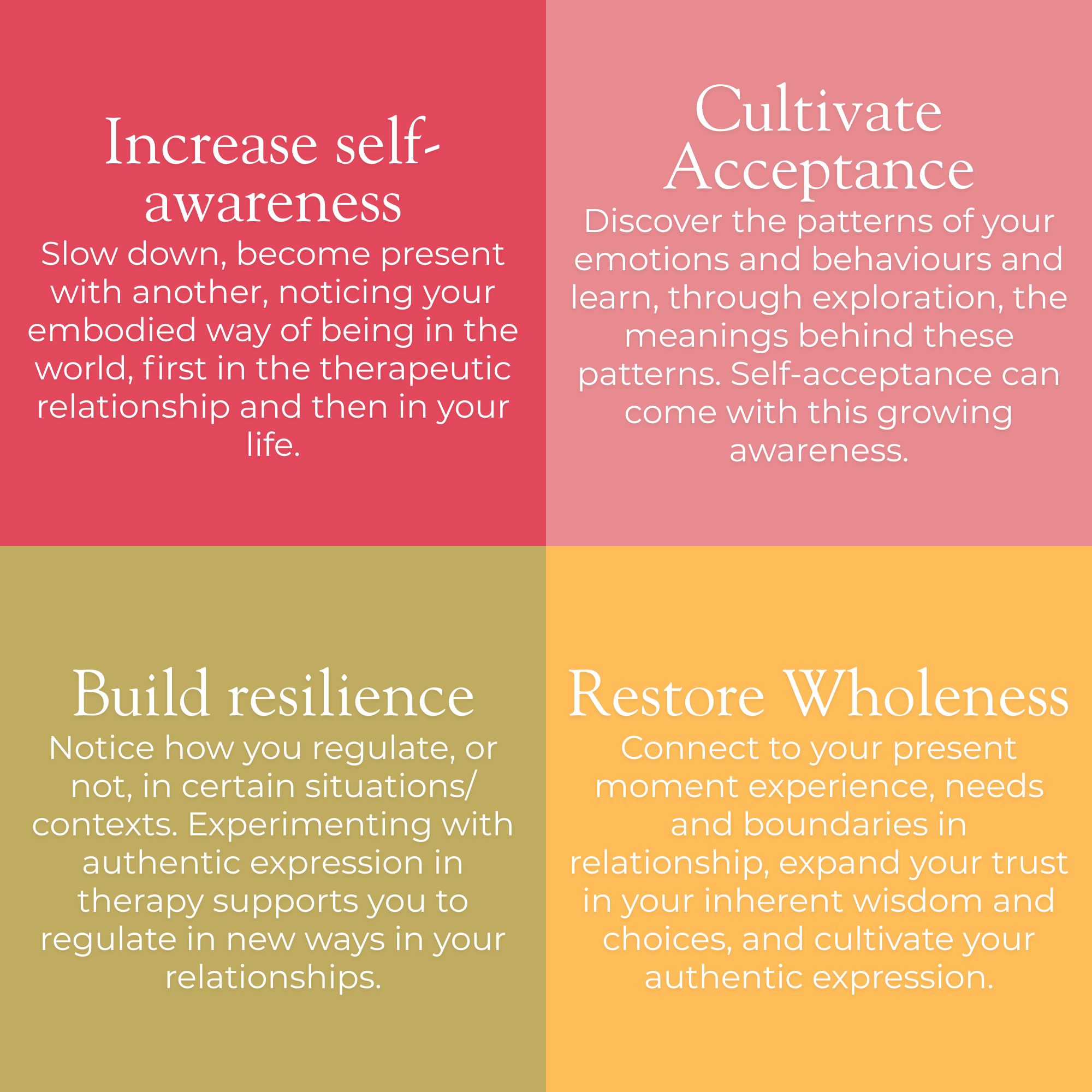
Gestalt therapy sessions are about experience more than about content. Gestalt therapy is known to be a process therapy rather than just talk therapy. What does this mean? The therapist may invite you to slow down and to notice the impact of what you are sharing. For example, you may be invited to notice the way you are breathing or tensing. If you reject this invitation the therapist will explore your choice with curiosity, rather than judgement. Each experience is welcomed and explored as an opportunity to support expression. All the while, the Gestalt therapist remains present to their own embodied experience, attuning to what resonates for them in the relationship. Experiments are introduced in collaboration with the client to facilitate expression and integration of emotions that may have been inaccessible before. The only goal of Gestalt therapy is to expand self-awareness and to restore choice-fullness. In time, as lost or rejected parts of us are integrated, we can start to feel more whole.
Benefits
Meet Our Therapists

Linda McConn
Counselling & Embodied (Gestalt) Psychotherapy (Fully Accredited).
"Linda’s style was very calm and measured and this meant that each session felt like a safe harbor. Her greatest strength was in offering challenges with warmth and the freedom to explore. She was particularly skilled at working with my metaphors, which we explored in depth.
Something that really stood out to me was that the insights from our work together stayed with me each time and were held in my mind between sessions. Each session led to new action, something that’s a credit to Linda’s coaching.
Linda is a coach who works with warmth and intuitive insight, whilst holding the space for challenge. Her greatest strength was in meeting me where I was. As a lover of language, visual imagery and metaphor, she embraced those elements of my thinking and worked with them."
Katie Poole, Coaching Client
"Linda became my coach at a time when I was stepping into a Senior Leadership position. From the beginning Linda was friendly, easty to talk to and empathetic to her coachee. Through our collaboration I learnt to notice not only my thoughts but also my body responses – she doesn’t only listen to words; she also listens to the unspoken body language. During our sessions I realised that all the answers I was looking for are within me. I also gained the confidence to speak my truth and to express my needs in order to reach my goals as a leader. I definitely would recommend Linda as a coach who I would like to work with again. Through her holistic coaching approach she managed to make me hear and understand myself."
Anna Kirikou, Coaching Client
Frequently Asked Questions about Embodied Psychotherapy/Gestalt therapy
What is embodied psychotherapy?
Embodied psychotherapy is therapy that works with mind, body and emotions together, helping you become more aware of what you feel and how you experience yourself in the present moment.
What is Gestalt psychotherapy?
Gestalt psychotherapy is a relational, experiential therapy that focuses on awareness, wholeness and how you are in relationship with yourself and others.
How does Gestalt therapy work with the body?
It may involve noticing posture, breath, tension, movement and sensation, using these as part of the therapeutic process rather than talking alone.
What happens in an embodied psychotherapy session?
The therapist may invite you to slow down, notice your body’s responses and explore your present experience through conversation and collaborative experiments.
Can Gestalt psychotherapy help build resilience and self-awareness?
Yes. Building self-awareness, resilience, acceptance and a stronger sense of wholeness are central aims of the work.